
Why I Spent My June Mornings Chasing Waterfalls Outside Seoul
I didn't come to Korea expecting waterfalls. Temples, yes. Street food, absolutely. But waterfalls tucked into forested mountains less than two hours from one of Asia's largest cities? That caught me off guard.
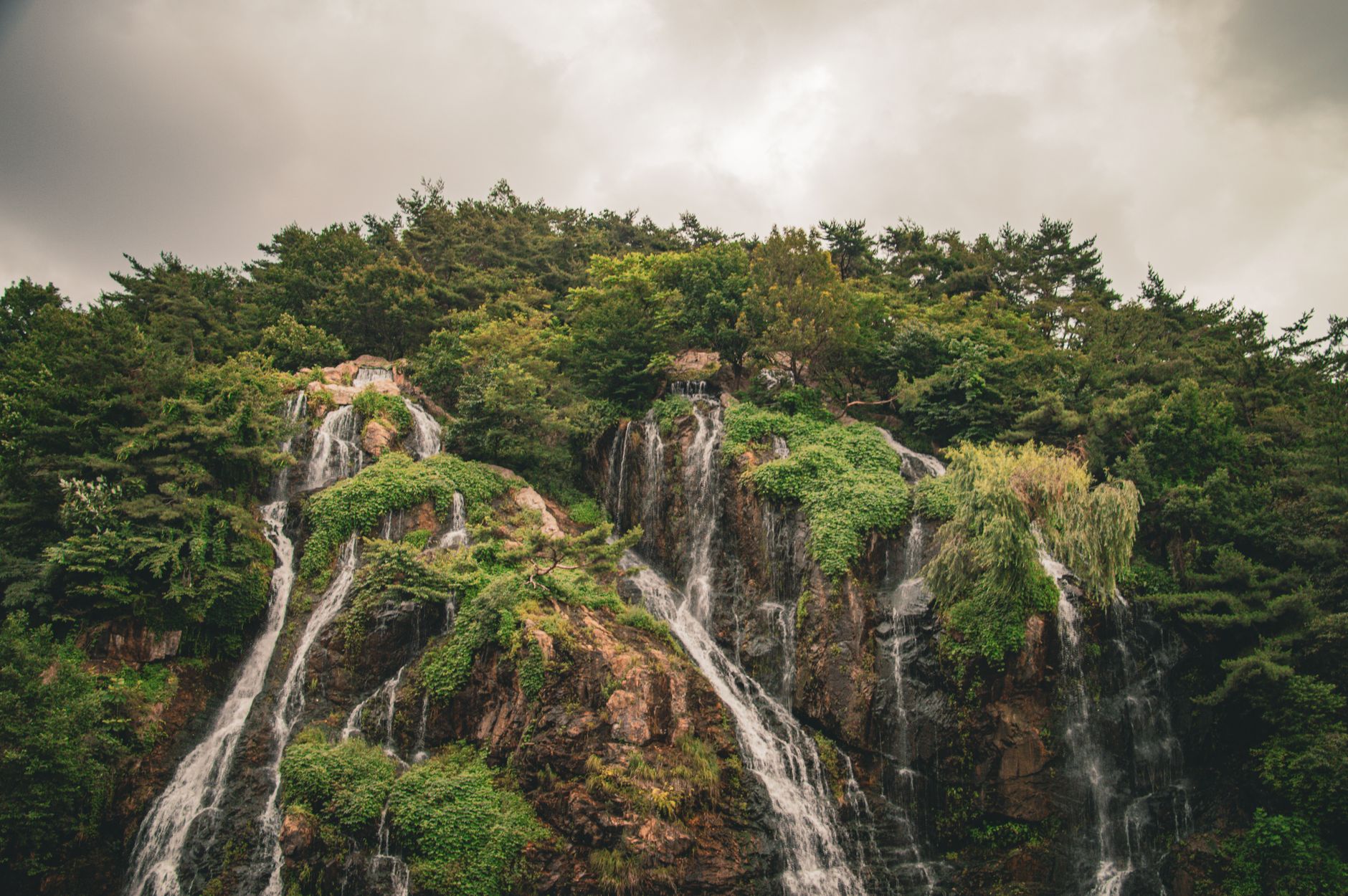
When I first started exploring Korea's hiking trails outside Seoul, I was honestly just looking for an escape from the summer humidity that blankets the city every June. What I found instead were trails that wind through cool, shaded gorges and end at waterfalls pouring down moss-covered rock faces — the kind of scenery that makes you forget you're a short bus ride from a metro area of 25 million people. The air temperature drops noticeably as you get closer to the falls, and standing at the base of a 15-meter cascade with mist hitting your face is about as far from the Gangnam crowds as you can get without leaving the country.
What I didn't expect was how accessible these hikes are. Korea's national and provincial parks are impeccably maintained — we're talking stone steps, wooden boardwalks, trail markers every few hundred meters, and rest pavilions with benches exactly where you need them. If you can handle stairs and a moderate uphill walk, you can reach most of these waterfalls. No scrambling, no bushwhacking, no guesswork.
If you're planning a Korea trip in 2026 and you'll be anywhere near Seoul between late May and early October, a waterfall hiking day trip should be on your list. Personally, I think June is the sweet spot — the falls are running strong from spring rain, the forests are impossibly green, and the monsoon season (which starts mid-to-late June most years) hasn't fully set in yet. Here's my honest breakdown of the best waterfall hikes I've done from Seoul, with real costs, transport details, and the things I wish someone had told me before I went.
🎟️ Pre-book this activity on Klook. Prices are competitive and cancellation is usually flexible.
Overview: Korea Waterfall Hiking Day Trips from Seoul in 2026
South Korea is roughly 70% mountains. That geological fact means there are hundreds of waterfalls scattered across the peninsula, many of them inside well-managed national or provincial parks with established trail systems. The mountains surrounding Seoul — Bukhansan to the north, the broader Gyeonggi Province ring, and the Gangwon Province ranges to the east — offer at least a dozen waterfalls reachable as a day trip.
💡 You can book tickets for this in advance on Klook — often cheaper than buying at the door, and you skip the queue.
The concept of a "day trip" here is generous. Korea's intercity bus network and KTX high-speed rail mean you can be standing at a trailhead 100+ kilometers away within 90 minutes of leaving Seoul Station. Most of the waterfalls I'll cover below require hikes between 30 minutes and 3 hours one-way, with well-marked trails rated easy to moderate. You don't need technical gear — proper hiking shoes, water, and sunscreen are enough.
Getting there from Seoul: Every destination below is accessible by public transit (bus or train + local bus/taxi). I'll give specific directions for each. A T-money card works on all intercity and local buses.
Rough budget range: A full day trip including transport, park entrance (most are free as of 2026), lunch, and snacks runs ₩25,000–₩55,000 ($18–$40 USD) per person depending on distance and how you eat.
Best Time to Visit — Waterfall Hiking Near Seoul
| Season | Crowds | Weather | Notes |
|---|---|---|---|
| Late May – Mid June | Moderate | Warm (20–28°C), occasional rain | ✅ Best balance — strong water flow, green forests, pre-monsoon |
| Late June – July | Lower (monsoon) | Hot, heavy rain likely | Falls are spectacular but trails can close during storms |
| August – September | Moderate–High | Hot & humid, typhoon risk | Post-monsoon falls are powerful; weekends very busy |
| October | Very High | Cool, dry, stunning foliage | Beautiful but water flow drops; expect crowds at popular parks |
Itinerary: 5 Best Waterfall Hikes for a Day Trip from Seoul
I've organized these from closest/easiest to farthest/most rewarding. You could reasonably do any single one as a relaxed day trip, or combine #1 and #2 if you're ambitious.
1. Yongmun Waterfall (용문 폭포) — Pocheon
Why go: This is the closest real waterfall experience to Seoul and one of the easiest hikes. The trail follows a stream through a forested valley, and the waterfall itself drops about 7 meters into a clear pool. It won't blow your mind compared to Iceland, but as a half-day escape from Seoul with minimal effort, it's hard to beat.
📍 Address: Idong-myeon, Pocheon-si, Gyeonggi-do
🚇 Getting there: Take Bus 72 from Uijeongbu Station (Line 1) to Pocheon, then local bus or taxi (₩12,000, ~$9) to the trailhead. Total transit: ~90 min from central Seoul.
⏱️ Time needed: 1.5–2 hours round trip hike + transit
💴 Admission: Free (as of 2026)
The hike: The trail is about 2.5 km one-way with gentle elevation gain — maybe 150 meters total. Wooden boardwalks cover the steeper sections. I saw couples in their 60s doing this trail comfortably with trekking poles. There are two rest pavilions with benches along the way. The last 300 meters gets a bit rocky underfoot, so real hiking shoes (not sneakers) make a difference.
Insider tip: Get there before 10 a.m. on weekends. Korean hiking culture means trails near Seoul fill up fast on Saturday mornings, and parking at the trailhead is limited.
Cost: ₩0 entrance + ~₩15,000 transport round trip (~$11 USD)
2. Biryong Waterfall (비룡 폭포) — Seoraksan National Park
Why go: Seoraksan is Korea's most famous mountain park, and Biryong ("Flying Dragon") Waterfall is its most iconic cascade — a 16-meter fall tucked into a dramatic granite gorge. The hike is moderate and the scenery along the way is some of the best I've encountered in Korea. This is a longer day trip but absolutely worth it.
📍 Address: Seorak-dong, Sokcho-si, Gangwon-do (Seoraksan National Park, Sogongwon area)
🚇 Getting there: KTX from Seoul → Gangneung Station (1 hr 40 min, ~₩27,600 one-way as of 2026), then Express Bus 1 to Sokcho Bus Terminal (50 min, ₩5,000), then local bus 7 or 7-1 to Seoraksan park entrance (20 min). Alternatively, intercity bus from Seoul Express Bus Terminal to Sokcho (2 hr 30 min, ~₩17,000).
⏱️ Time needed: Full day — 5–6 hours including transit each way, plus 2.5–3 hours hiking round trip
💴 Admission: Free (national park entrance fees were abolished in 2007 and remain free as of 2026). Cable car to Gwongeumseong is separate if you want to add that — ₩17,000 round trip (~$12).
The hike: From the Sogongwon ticket office area, the trail to Biryong Waterfall is about 2.4 km one-way. You'll cross a couple of wooden bridges over a boulder-strewn stream, climb stone steps through dense forest, and pass Yukdam (Six Pools) waterfall along the way — which is honestly beautiful enough to be a destination on its own. The final approach to Biryong involves a metal staircase bolted into the rock face. It's stable and has railings, but if heights bother you, take it slow.
The mist at the base of Biryong in June is heavenly. I stood there for 15 minutes just cooling off. Bring a light rain jacket — you will get damp.
Insider tip: If you're taking the KTX route, book the 6:30 or 7:00 a.m. train from Seoul. This gives you a full morning at Seoraksan and time to grab fresh squid or seafood in Sokcho before heading back.
Cost: ₩0 entrance + ~₩55,000–₩65,000 transport round trip (~$40–$47 USD)

🛏️ Still looking for somewhere to sleep? Agoda has solid options across all price ranges, with free cancellation on most bookings.
🇰🇷 Useful Korean — On the Trail
- 안녕하세요 (an-nyeong-ha-se-yo) — "Hello / Good day" (greet fellow hikers — it's customary in Korea)
- 사진 찍어도 돼요? (sa-jin jji-geo-do dwae-yo?) — "May I take a photo?"
- 화장실 어디예요? (hwa-jang-sil eo-di-ye-yo?) — "Where is the restroom?"
- 감사합니다 (gam-sa-ham-ni-da) — "Thank you (formal)"
3. Yongchu Waterfall (용추 폭포) — Gapyeong
Why go: Gapyeong is already a popular day trip from Seoul (Nami Island, Petite France), but most tourists skip Yongchu Falls entirely. That's a mistake. This two-tiered waterfall drops into a deep emerald pool surrounded by granite cliffs, and the hike to get there is a pleasant 40-minute walk along a stream. It's easy enough for anyone in reasonable shape.
📍 Address: Bukhan-gang area, Gapyeong-gun, Gyeonggi-do
🚇 Getting there: ITX-Cheongchun train from Yongsan or Cheongnyangni Station to Gapyeong Station (55 min–1 hr 10 min, ~₩4,800). From Gapyeong Station, take local bus or taxi (₩8,000–₩12,000) to the Yongchu Valley area.
⏱️ Time needed: 3–4 hours including the hike and time at the falls
💴 Admission: Free (as of 2026)
The hike: This is more of a valley walk than a mountain hike. The trail follows the stream for about 1.8 km with minimal elevation change — think 50 meters total. There are stepping stones across the stream at a couple of points; they can be slippery after rain, so watch your footing. The waterfall itself is about 9 meters tall, and the pool at the base is popular with Korean families for wading (ankle to knee-deep around the edges).
To be fair, Yongchu is smaller and less dramatic than Biryong. But the accessibility makes it ideal if you're combining it with other Gapyeong attractions, and the crowd levels are a fraction of Nami Island.
Insider tip: Pack kimbap or sandwiches from a convenience store and eat at the flat rocks near the falls. There are no restaurants along the trail.
Cost: ₩0 entrance + ~₩20,000–₩30,000 transport round trip (~$15–$22 USD)
4. Sambuyeon Falls (삼부연 폭포) — Cheorwon, Gangwon-do
Why go: This is a designated Natural Monument (No. 1318) and one of the most photogenic waterfalls in northern Gangwon Province. The falls cascade down three tiers of basalt rock — the legacy of ancient volcanic activity from nearby Hallasan (different geological period, same drama). The surrounding forest is dense and feels almost primeval. Cheorwon also has the fascinating DMZ Peace Trail nearby if you want to combine nature with history.
📍 Address: Galmal-eup, Cheorwon-gun, Gangwon-do
🚇 Getting there: Intercity bus from Dong Seoul Bus Terminal to Cheorwon (2 hr, ~₩11,000 one-way). From Cheorwon bus terminal, taxi to Sambuyeon trailhead (15 min, ~₩8,000).
⏱️ Time needed: Full day — 4–5 hours transit round trip + 1.5–2 hours at the falls
💴 Admission: Free (as of 2026)
The hike: Honestly, calling this a "hike" is generous. It's a well-maintained 800-meter path from the parking area to the viewing platform. Paved and stepped the whole way. The viewing platform gives you a clear look at all three tiers. There's an upper trail that adds another kilometer if you want to see the falls from above — that section has some uneven steps but nothing technical.
I was surprised by how powerful the falls were in early June. The basalt columns framing the water give the whole scene an almost Icelandic quality. I've seen photos from autumn that look incredible too, but in June the green canopy overhead creates a natural filter that's perfect for photography.
Insider tip: Cheorwon is also home to the Cheorwon Peace Observatory and DMZ areas. If you start early, you can visit Sambuyeon Falls in the morning and book an afternoon DMZ tour. Check current DMZ tour availability — some require ID registration 3 days in advance.
Cost: ₩0 entrance + ~₩30,000–₩38,000 transport round trip (~$22–$28 USD)
5. Cheonjiyeon & Jeongbang Falls — Jeju Island (Bonus: Flight Day Trip)
I'm including Jeju as a bonus because technically you can do it as a day trip from Seoul — and if you're a waterfall lover, Jeju has two of Korea's most famous. Jeju Air and Korean Air run flights from Gimpo Airport roughly every 30 minutes, and the flight is only 70 minutes.
Cheonjiyeon Falls (천지연 폭포)
📍 Address: 2-5 Cheonjiyeon-ro, Seogwipo-si, Jeju
🚇 Getting there: From Jeju Airport, Airport Limousine Bus 600 to Seogwipo (80 min, ₩5,500), then 10-min walk
⏱️ Time needed: 1–1.5 hours
💴 Admission: ₩2,500 (~$1.80 USD, as of 2026)
Jeongbang Falls (정방 폭포)
📍 Address: 37 Chilsimni-ro214beon-gil, Seogwipo-si, Jeju
⏱️ Time needed: 45 min–1 hour
💴 Admission: ₩2,000 (~$1.45 USD, as of 2026)
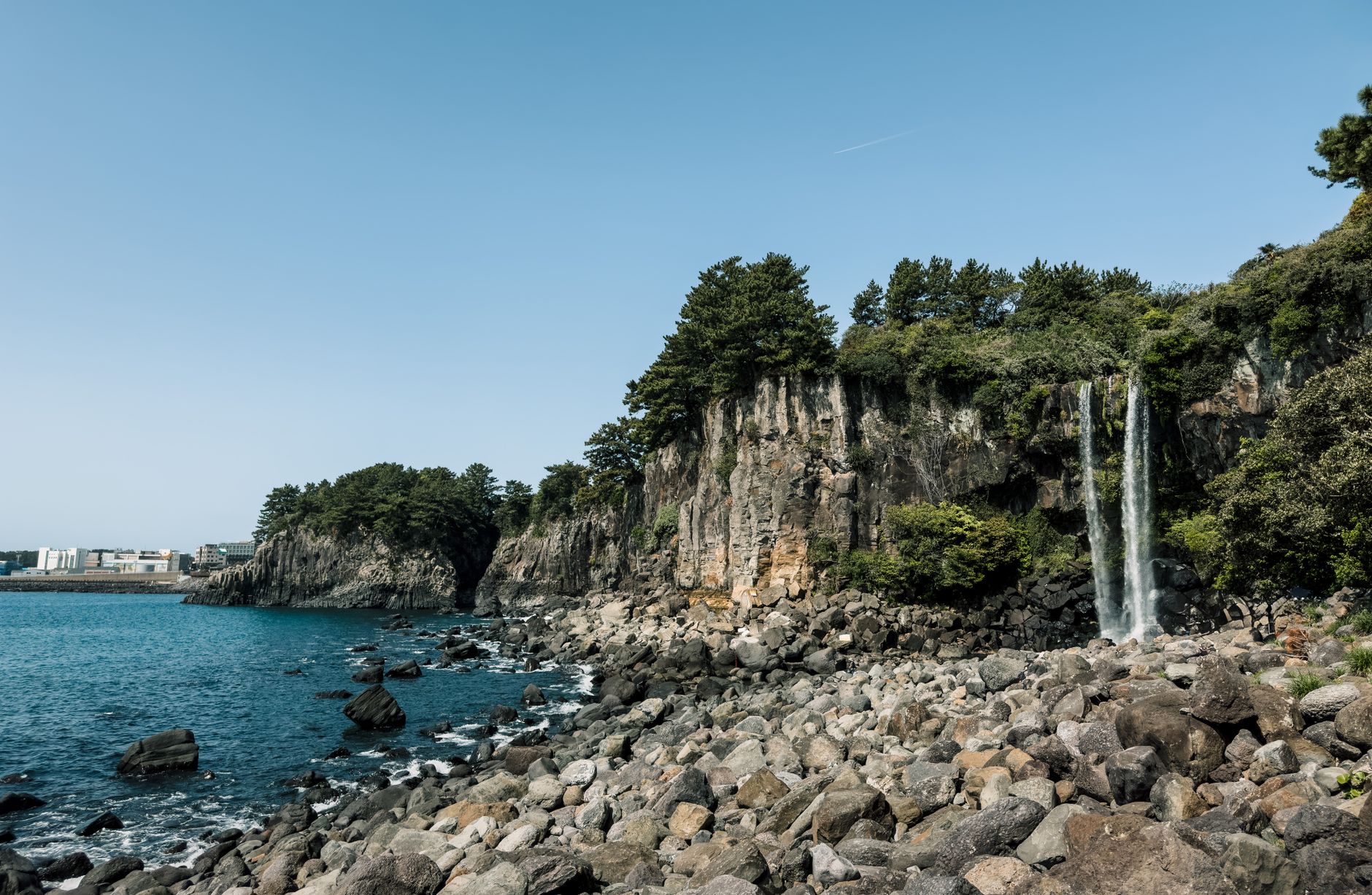
Jeongbang is famous as the only waterfall in Asia that falls directly into the ocean — the 23-meter cascade drops off a cliff straight into the sea. It's dramatic. Cheonjiyeon, meanwhile, is a lush subtropical gorge with a wide 22-meter fall surrounded by rare Dampalsu trees.
Honestly, a Jeju day trip is doable but rushed. If you have even one extra day, staying overnight in Seogwipo makes it far more enjoyable. But I've done the dawn-flight-out, last-flight-back routine, and it works if you're disciplined about time.
Cost: Round-trip flight ₩80,000–₩140,000 (~$58–$102, book 2+ weeks ahead for better fares) + local transport + admission
🇰🇷 Useful Korean — Food Stops After Hiking
- 이거 주세요 (i-geo ju-se-yo) — "This one, please" (point at menu or photo)
- 덜 맵게 해 주세요 (deol maep-ge hae ju-se-yo) — "Less spicy, please"
- 물 주세요 (mul ju-se-yo) — "Water, please"
- 맛있다! (ma-sit-da!) — "This is delicious!"
- 카드 돼요? (ka-deu dwae-yo?) — "Do you accept card?"
Real Cost Breakdown: Korea Waterfall Day Trip from Seoul (2026)
Here's what I actually spent on my Seoraksan/Biryong Waterfall day trip, which is the most expensive option on this list:
| Item | Detail | KRW | USD (approx) |
|---|---|---|---|
| Transport | KTX Seoul → Gangneung (round trip) | ₩55,200 | ~$40 |
| Transport | Express bus Gangneung → Sokcho (round trip) | ₩10,000 | ~$7 |
| Transport | Local bus to Seoraksan (round trip) | ₩3,000 | ~$2 |
| Food | Kimbap + coffee (trailhead) | ₩7,500 | ~$5.50 |
| Food | Seafood lunch in Sokcho | ₩15,000 | ~$11 |
| Snacks | Trail snacks + water | ₩4,000 | ~$3 |
| Admission | National park | ₩0 | Free |
| Other | T-money top-up / misc | ₩5,000 | ~$3.60 |
| Total | Full-day Seoraksan trip | ₩99,700 | ~$72 |
For the closer options (Pocheon, Gapyeong, Cheorwon), expect roughly half that — ₩35,000–₩55,000 ($25–$40) for the day.
Budget Tier Comparison — Waterfall Day Trip from Seoul
| Comfortable | Premium | Splurge | |
|---|---|---|---|
| Per day | ₩35K–60K (~$25–44) | ₩80K–150K (~$58–109) | ₩200K+ (~$145+) |
| Transport | Public bus all the way | KTX + local bus | KTX first class or private car/driver |
| Food | Convenience store kimbap + local restaurant | Sit-down Korean restaurant near park | Upscale restaurant in Sokcho or Gapyeong |
| Extras | Hike only | Hike + cable car or nearby attraction | Hike + spa/jjimjilbang + cultural experience |
| Style | Pack your own snacks, early start | Balanced comfort, book KTX in advance | No rushing, taxi between points, premium seats |
🎧 Good background for trip planning — GrooveSeoul Studio posts café ambience and night-view footage from across Korea. Worth bookmarking.
Practical Tips & Warnings for Summer Waterfall Hiking in Korea (2026)
1. Bring Real Hiking Shoes — Not Sneakers
📍 View on Google Maps
Korean trails near waterfalls have wet rocks, slippery wooden bridges, and muddy patches after rain. I saw a woman in canvas sneakers slip near Biryong Falls and scrape her hands badly. Trail shoes with ankle support and grip soles make a real difference. You can buy affordable pairs at Decathlon in Seoul (there's one in Gangnam and one in Jamsil) for around ₩40,000–₩60,000.
2. Start Early — Korean Hikers Are Early Risers
📍 View on Google Maps
Koreans take hiking seriously. Weekend trailheads near Seoul can be packed by 9 a.m. For the best experience (fewer people, cooler temperatures, better parking), aim to start your hike by 8:00–8:30 a.m. This is doubly true in June when afternoon humidity can be brutal.
3. Monsoon Awareness (장마 / Jangma)
📍 View on Google Maps
Korea's monsoon season typically begins mid-to-late June 2026. Heavy rains can cause trail closures, landslide warnings, and flash flooding in valley areas near waterfalls. This is not a minor concern — trails close and parks issue emergency alerts. Always check the Korea Meteorological Administration (weather.go.kr, English available) and the Korea National Park Service app before heading out.
4. T-Money Card Is Essential
📍 View on Google Maps
Load a T-money card (buy at any convenience store for ₩2,500 card fee) and top it up. It works on Seoul metro, all city buses, intercity buses, and even taxis. You can also use it to buy drinks from vending machines at trailheads. This is the single most useful thing you can carry in Korea.
5. Pack Your Trash Out — And Then Some
📍 View on Google Maps
Korea's hiking culture has a strong "leave no trace" ethic, and many trailheads have signs asking hikers to carry trash out. Some remote trails have zero trash bins. Bring a small bag for your waste. Personally, I carry a ziplock bag in my daypack.
6. Sunscreen and Bug Spray in June
📍 View on Google Maps
Mosquitoes near streams and waterfalls in June are no joke. I got bitten 14 times on one Gapyeong hike because I forgot repellent. Apply DEET-based spray or buy Korean brand 모기 물린데 (mogi mullin-de) patches at any pharmacy (약국 / yakguk) or convenience store.
7. Hydration and Rest Stops
📍 View on Google Maps
Most established trails have rest pavilions (정자 / jeongja) every 500–800 meters with benches and sometimes shade structures. Take advantage of these — especially in summer heat. Convenience stores at trailheads sell 2L water bottles for ₩1,000–₩1,500. Buy two.

How Long Do You Need for a Waterfall Day Trip from Seoul?
For the closest waterfalls (Pocheon, Gapyeong), you need about 5–6 hours door-to-door from central Seoul, including transit and a comfortable-paced hike. For Seoraksan or Cheorwon, plan a full day — leave Seoul by 7 a.m. and return by 7–8 p.m. For Jeju, you'd need to catch a 6–7 a.m. flight and return on an 8–9 p.m. flight, making it a 14–15 hour day. Personally, I recommend Seoraksan as the most rewarding single-day waterfall trip — the scenery justifies the longer travel time, and the KTX makes it surprisingly painless.
✅ Trip Checklist: Korea Waterfall Day Hike
- [ ] Hiking shoes with grip soles (not sneakers or sandals)
- [ ] Light rain jacket — doubles as wind layer and waterfall mist protection
- [ ] T-money card loaded with at least ₩20,000
- [ ] 2L water + electrolyte packets (sold at GS25, CU convenience stores)
- [ ] Sunscreen SPF 50+ and mosquito repellent
- [ ] Portable battery pack — GPS navigation drains your phone fast
- [ ] Offline map downloaded (Naver Map recommended over Google Maps)
- [ ] Small towel or bandana — sweat and waterfall mist
- [ ] Trail snacks: kimbap, energy bars, fruit (buy at trailhead convenience store)
- [ ] Ziplock bag for trash and keeping your phone dry near falls
- [ ] KTX tickets booked in advance (if going to Seoraksan or using rail)
🇰🇷 Useful Korean — Getting Around
- 여기 가 주세요 (yeo-gi ga ju-se-yo) — "Please take me here" (show address on phone to taxi driver)
- 천천히 말해 주세요 (cheon-cheon-hi mal-hae ju-se-yo) — "Please speak slowly"
- 얼마예요? (eol-ma-ye-yo?) — "How much is it?"
- 감사합니다 (gam-sa-ham-ni-da) — "Thank you"
FAQ: Korea Waterfall Hiking Day Trips from Seoul
Q: Is hiking to waterfalls in Korea safe for beginners?
A: Yes. The trails listed here range from easy (paved, 800 meters) to moderate (2.5 km with stone steps). Korea's national park trails are well-maintained with clear markers, railings on steep sections, and rest stops. You don't need prior hiking experience, but you do need decent shoes and basic fitness — expect stairs.
Q: Can I swim at Korean waterfalls?
A: At most waterfalls inside national parks, swimming directly at the falls is prohibited for safety reasons. However, some downstream pools and valley streams (like at Yongchu Falls in Gapyeong) allow wading. Look for areas where Korean families are already in the water — that's your cue it's permitted. Never swim alone or during heavy rain.
Q: What is the best waterfall near Seoul for older travelers or those with limited mobility?
A: Sambuyeon Falls in Cheorwon is the most accessible — the trail is only 800 meters, mostly paved, with gentle steps. Yongchu Falls in Gapyeong is also very manageable with minimal elevation change. Both are comfortable for travelers in their 60s and beyond. Bring trekking poles if your knees are a concern — you can buy cheap ones at Daiso in Seoul for ₩5,000.
Q: Do I need to book anything in advance for waterfall hiking?
A: The hikes themselves don't require reservations. But if you're taking the KTX to Seoraksan (via Gangneung), book your train tickets 1–2 weeks ahead on weekends — summer 2026 seats sell out. Also, some national parks limit daily visitors during peak periods. Check the Korea National Park Service website (english.knps.or.kr) before your trip.
Q: Is June a good month for waterfall hiking in Korea?
A: Early-to-mid June (like right now in 2026) is excellent. The waterfalls run strong from spring rain, forests are lush green, and temperatures are warm but not yet at peak summer heat. Watch the monsoon forecast — jangma season usually begins late June and can cause trail closures. Check weather daily.
Q: What should I eat after a waterfall hike?
A: Korean post-hike food culture is real. Near mountain trailheads, you'll find restaurants serving pajeon (scallion pancake, ~₩10,000), makgeolli (rice wine, ~₩5,000 a bottle), and bibimbap (~₩8,000–₩10,000). In Sokcho near Seoraksan, fresh seafood — especially ojingeo sundae (stuffed squid) — is the move. In Cheorwon, go for dakgalbi. These meals are hearty, affordable, and incredibly satisfying after a morning on the trail.
Q: Are there waterfalls I can see without hiking at all?
A: Yes. Jeongbang Falls in Jeju requires only a short walk down steps from the entrance (about 5 minutes). Cheonjiyeon Falls is also a short, paved walkway. On the mainland, Sambuyeon Falls is essentially a walk, not a hike. If you want the waterfall photo without the workout, these are your best options.
Related Posts
이미지 출처: Photo by 정규송 Nui MALAMA on Pexels | Photo by Kharl Anthony Paica on Pexels | Photo by Kwangho Cha on Pexels | Photo by Joel M B Marrinan on Pexels | Photo by Saksham Vikram on Pexels


0 Comments